What about Mamdani’s markets in NYC food deserts?

I’ve seen bizarre remarks about this really really good idea which would provide underserved NYC neighborhoods with food markets at a lower cost than supermarkets. A lower cost because the City would own or rent the space and invite vendors to set up shop within the space. Given their rent-free occupation, Mamdani points out they could charge reasonable prices, lower than supermarkets.

The major sneer is, “Oh yeah, and government is just great at things like this!”

Actually, government is just great at things like, oh, Social Security, Medicare, Medicaid and a slew of other effective agencies which provide us all with vital needs at lower costs than corporate entities. (Talk to any of us who are on Medicare about the private health insurance companies who have bulled their way into grabbing Medicare funds for their own private pockets!! Cover your ears while we scream in fury.)

Anyhow, back to government-owned food markets. When I first heard about Mamdani’s idea, I thought it was terrific. Then I began imagining what these markets could look like, and how they could support small food businesses. And immediately I thought of Essex Market. Could these markets look like Essex Market (the new Essex Market)?

Yes, they could. And then I found out that Essex Market is...publicly owned and operated by…a New York City agency! Take a look at it. ⇑ It’s spectacular and so are the vendors, and the take-out places serving yummy fresh-made food which you can eat at the tables distributed throughout the multi-level place. (I ate and shopped there once.)

If I lived down there, this is where I’d be shopping.

That’s what Zohran Mamdani is envisioning and it’s excellent.

Posted in Capitalism, Culture, Government, political campaigns, Politics, The Facts of Life | Tagged , , , , , | Comments Off on What about Mamdani’s markets in NYC food deserts?

Pete Hegseth & his boss versus America’s real warriors

As you know, Pete Hegseth summoned the entire upper echelon of our military to D.C. yesterday so he and his, uh, commander in chief, could harangue our defense professionals with, well, rah-rah speeches that absolutely must have been composed specifically so the news media, political pundits and the rest of the sane world could ridicule and mock them. (We are watching a sort of comedic Grand Guignol written, produced and performed by warped, stupid children, an administration consisting of juvenile bad seeds and their dreadful nannies.)

It happens that I’m reading the last chapters of a great history by Eric Larrabee, Commander in Chief: Franklin Delano Roosevelt, His Lieutenants, And Their WarI have found it remarkably thrilling, exciting, revelatory, even sort of profound.

Remarkable, because until recently my attitude toward war was entirely adverse. I once said to my father, re Vietnam, I couldn’t understand how advanced civilizations couldn’t figure out another way of settling conflicts other than killing people and wrecking whole countries. His reaction was silent contempt. Which did not cause me to quail. It’s how I thought and what I believed: War was mankind’s greatest horror, and apparently its most irreparable glitch.

Then why have war and war history become so important to me? I’m not sure. I am sure, though, that war is a reality — an insupportable reality, sure, but horror at it doesn’t deny its perpetual existence. (Not incidentally, the most solemn place I’ve ever visited is the American Cemetery above Omaha Beach in Normandy.)

So the only way I can recognize war’s eternality is to try to understand it, to understand how mankind somehow designated frequent regimented violence and destruction as a way of the world, so much so that apparent gross contradictions like “war colleges” and “war institutes” are serious advanced educational opportunities.

That’s why I’ve been reading war and why I’m enthralled by Commander in Chief, the most powerful pull in which is the fascinating biographies of the title’s “lieutenants,” their personal lives and characters, and then how each managed his division of the war.

I knew some of the names but not others, and I knew little about any of their actions in the war — except for the culmination — but Larrabee’s writing is so vivid, I found myself in the battles with them and their soldiers.

No war movie has ever been as vivid as this book.

The culture of the military has always been alien to me. We had a couple of uniforms in my family during World War II, but never since. I’ve come to realize many families embrace the culture by admiring their members who wear uniforms, by regarding the military as a high profession, as other families like mine value education, law, medicine.

But now I’m awed at those great high commanders, some of whom indeed had graduate degrees in education, law and medicine. In the history of this country, those guys were something else. In our current lexicon, they were superstars.

Look at the photos of our current diverse military leadership, sitting poker-faced in an auditorium, listening to those two rotting idiots. There is no reason for me to think these stoical people wearing all those medals are less formidable, less intelligent, less integrated or less capable of joining us to save America from fascism than were their World War II predecessors.

Posted in Culture, Fascism, MAGA, Politics, The Facts of Life, Trumpism, War | Tagged , , , , , , , , , , , , | 1 Comment

Scenes from my life: Meeting Robert Redford

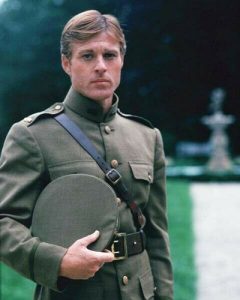
He was wearing a World War I US Army uniform…
I was wearing a summer sweater and white jeans…

 …with my Paramount Pictures ID badge 181 pinned on.

The setting was a palatial room at Marble House, one of Newport’s grand mansions. The room itself, a soaring ballroom, was indescribably glorious, glimmering with crystal, the sheen of marble, the walls papered in gold leaf.

On that day in 1973, my first on the Newport location, the ballroom was being employed as a fantastical set, Jay Gatsby’s ballroom for one scene in Paramount’s film, The Great Gatsby. A block or so away from Marble House was Rosecliff, the grand Stanford White mansion the interior and exterior of which we used as Gatsby’s house. I don’t recall that Rosecliff had an appropriate room, both intimate and impossibly gorgeous, for this two-person moment.

The dreamlike scene shot that day does not exist in the novel. Francis Coppola, who’d written the screenplay, had created this brief romantic moment in which Gatsby, dressed in the uniform he’d worn when he first met Daisy, dances slowly and romantically with her.

That was the shot. Aside from that one area, the ball room had clusters of film equipment  and the technicians who operated the equipment. A lot of people, a lot of smooth motion.

I did not yet know any of the crew aside from the director, Jack Clayton, and Hank Moonjean, the producer, who was fast becoming one of my lifelong friends, so I did not seek out my favorite viewing perch, the microphone platform. Would’ve been arrogant; I wasn’t even assertive. Instead, I fit myself in among the numerous spectactors lining a golden wall opposite the scene.

Lights came on, Jack said, “Action,” Gatsby and Daisy danced. “Cut;” they stopped dancing. Another take followed that one, and again, “cut” and the lighting faded.

From that circumscribed dance floor, Gatsby turned, looked in my direction, stepped out of the scene and walked toward me.

As he moved forward, something happened. I sensed it then, but at the time my sense was inchoate and I could not have described it. I can now. As the dazzlingly beautiful man in his war uniform left the area of the shot, as he walked toward me, he became Bob Redford. He had somehow — and I don’t believe he was conscious of doing it, or in control of it — shed the glowing aura around him as he moved, and had become, simply, a human being. A very handsome human being, yes, but not godlike, not overwhelming.

As he reached me, he said, “Hi, I’m Bob Redford.” He asked who I was. I introduced myself and, as an explanation for what I was doing there (which he had requested in a friendly, curious way), offered him whatever Paramount title I’d stitched together for my presence on the film.

Whatever it was, it was modest; as a film executive (minor), I was an “executive,” and rather shy about the title, since I was conscious of how ill-fitting it was. That was OK, because Bob seemed a bit shy, too, like a teenage boy who had rehearsed the introduction in his mind.

Immediately, I found him comfortable to be with, easy to talk with. I don’t recall what we said to each other then, not because I was awed into monosyllables but because it wasn’t memorable.

And so it was for the many months of Gatsby. We didn’t hang out, or search out each other on the numerous locations and sets where each of us happened to be. But there were occasions for conversations.

Bob had created a warm mutuality. Lovely.

Posted in The Facts of Life | Tagged , , , , , , , , , , , , , | Comments Off on Scenes from my life: Meeting Robert Redford