
I would’ve missed knowing Albert Brenner as a friend if my dear pal, Susan, hadn’t married him more than 40 years ago. But I would have known him anyway because of the look of the films he designed so brilliantly.
I met Albert in a unique sort of way. A few years before I went to L.A. for their wedding, Sue called me to say Albert was in New York on a work trip, and could he come over to my place to…collect my apartment?
Maybe she didn’t phrase it that way. More likely she explained that Albert compiled his own research files by taking photos of apartments and other interiors he later could use as exemplars when he worked on a film.
Of course I said sure. Indeed, my apartment, a high-ceilinged studio in a 150 year old Greenwich Village townhouse, had picturesque aspects. So Albert arrived with camera while I watched in curiosity, as he focused on corners and some sloppy little areas I’m sure I apologized for: “Oh, some day I’ll get to finishing that.” He didn’t care; those quirks were precisely what he wanted.
I was equally impressed with Albert, the person. For a compact guy, he had a large presence. A majestic pile of silver hair and spectacular mustache. He was warmly pleasant but mostly professional, serious and intense.
Years later, I inquired as to whether my apartment had made an appearance in any of his films. “Yes,” I was told, “but you wouldn’t have recognized it.” It had somehow expanded and become futuristic, I think.
I’ve been having a sort of Albert Memorial of my own over the past several months since, on December 8, I learned he’d moved on to another film location. Some of his movies have been showing up on my streaming channel. Given how many movies Albert made, I expect always to run into them on whatever channel I’m streaming. For me, they’ll always be Albert’s movies, no matter who produced or directed them, because his great gift as an art director was idiosyncratic and noticeable, if you knew what to notice. But the thing is, his great gift as an art director was to make places so non-contrived, so real, you probably wouldn’t see what he’d done. You might not even know it was done.
An example. Interior apartment doors. In his designs for thoroughly lived-in apartments, Albert made sure the hint of fingermarks were on the door, exactly where they’d be if the residents had constantly grabbed the door with slightly mucky fingers and the landlord was ignoring his obligation to paint every two years. Try The Goodbye Girl for those doorway fingermarks, and for Albert’s wit.
This might sound odd, but my favorite Albertism, in one of my all-time favorite films, Bullitt — I will watch it any time, any where — is not about the car chase. It’s the hospital setting, when the guy Bullitt is supposed to be protecting has died from a explosive gunshot assassination.
Instead of a sleekly ordered medical setting populated with shiny scientific equipment and crisp personnel, the Bullitt hospital looked like a very busy, fairly shabby city hospital, the counters and desks cluttered with stuff, with packages, papers, as if the ER staff had no time to clean things up, while through glass doors and windows emergency rooms were crammed with people and bloody fabrics.
Knocks me out.
A few years after Albert collected my apartment, he asked me to do some collecting myself: the offices and on-air studios of a couple of New York’s radio stations. Per his instructions, I set up a (rented) camera in the open office spaces and clicked away, focusing, as he instructed me, on Albertisms: close-ups of desks, trash cans, telephones.
I remember shooting half-finished candy bars on someone’s desk, and messy piles of papers, while behind the glass in small enclosures, radio reporters’ lips moved as they gave us the news and weather which was broadcast at a low level throughout the newsroom.
How difficult is it to tell personal stories about the lives of loved friends? When those stories are fragments of memory, sort of still photos or short videos we’ve collected in our minds?
Sue and Albert’s wedding, when they were united and blessed…by their accountant, who’d gotten certified beyond accountancy for the ceremony. How witty this was, how original, and loveable.

One day during that wedding trip I made to LA, a small group of Susan and Albert’s friends sat at their large kitchen counter while Albert recited, with endearing charm and from memory, portions of Winnie The Pooh, turning us into delighted children for those minutes.
After that time, we all met up at least once a year at our friend Elizabeth’s house in Jersey, for Christmas or for the best traditional occasion, deep friendship. Susan and Albert were often stopping off on their way to Pietrasanta, a Tuscan town where they were living — and Albert, working — for half the year.
Albert had moved on from sculpting three-foot-high ladies, at least a few prostitutes, in acrylic resin. In Pietrasanta, a rather specific sculptor’s town lying on a flat plain beneath the Carrara mountains, he was working at a foundry, making figures in wax which would, through an ancient method called the lost wax process, be cast in bronze. Beautiful work.
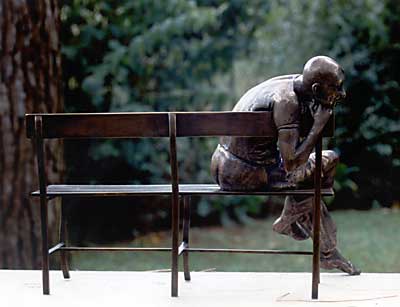
I visited Sue and Albert in Pietrasanta. My first evening, stoned on jet lag, they took me to an outdoor café in the beautiful village square, where I had prosecco for the first time while gazing upon a Roman wall.
After a few years, Sue and Albert moved back to L.A. permanently. I didn’t see them as often, then. Time passed, and shifted.
Sue told me about the internment, when Albert’s ashes were placed in a columbarium niche. It seems no more possible to me than my mother’s, also in a columbarium. The strength of a life remains at home with us, to talk to, to argue with, to apologize, to love.
And to smile. Here’s the memory Sue mailed, a lovely picture, an even better laugh.

