
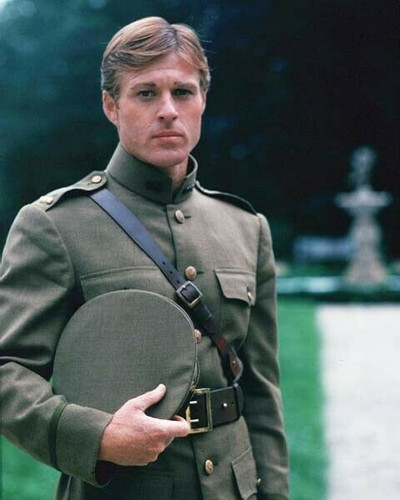
He was wearing a World War I US Army uniform…
 I was wearing a summer sweater and white jeans…

 …with my Paramount Pictures ID badge 181 pinned on.
The setting was a palatial room at Marble House, one of Newport’s grand mansions. The room itself, a soaring ballroom, was indescribably glorious, glimmering with crystal, the sheen of marble, the walls papered in gold leaf.
On that day in 1973, my first on the Newport location, the ballroom was being employed as a fantastical set, Jay Gatsby’s ballroom for one scene in Paramount’s film, The Great Gatsby. A block or so away from Marble House was Rosecliff, the grand Stanford White mansion the interior and exterior of which we used as Gatsby’s house. I don’t recall that Rosecliff had an appropriate room, both intimate and impossibly gorgeous, for this two-person moment.
The dreamlike scene shot that day does not exist in the novel. Francis Coppola, who’d written the screenplay, had created this brief romantic moment in which Gatsby, dressed in the uniform he’d worn when he first met Daisy, dances slowly and romantically with her.
That was the shot. Aside from that one area, the ball room had clusters of film equipment and the technicians who operated the equipment. A lot of people, a lot of smooth motion.
I did not yet know any of the crew aside from the director, Jack Clayton, and Hank Moonjean, the producer, who was fast becoming one of my lifelong friends, so I did not seek out my favorite viewing perch, the microphone platform. Would’ve been arrogant; I wasn’t even assertive. Instead, I fit myself in among the numerous spectactors lining a golden wall opposite the scene.
Lights came on, Jack said, “Action,” Gatsby and Daisy danced. “Cut;” they stopped dancing. Another take followed that one, and again, “cut” and the lighting faded.
From that circumscribed dance floor, Gatsby turned, looked in my direction, stepped out of the scene and walked toward me.
As he moved forward, something happened. I sensed it then, but at the time my sense was inchoate and I could not have described it. I can now. As the dazzlingly beautiful man in his war uniform left the area of the shot, as he walked toward me, he became Bob Redford. He had somehow — and I don’t believe he was conscious of doing it, or in control of it — shed the glowing aura around him as he moved, and had become, simply, a human being. A very handsome human being, yes, but not godlike, not overwhelming.
As he reached me, he said, “Hi, I’m Bob Redford.” He asked who I was. I introduced myself and, as an explanation for what I was doing there (which he had requested in a friendly, curious way), offered him whatever Paramount title I’d stitched together for my presence on the film.
Whatever it was, it was modest; as a film executive (minor), I was an “executive,” and rather shy about the title, since I was conscious of how ill-fitting it was. That was OK, because Bob seemed a bit shy, too, like a teenage boy who had rehearsed the introduction in his mind.
Immediately, I found him comfortable to be with, easy to talk with. I don’t recall what we said to each other then, not because I was awed into monosyllables but because it wasn’t memorable.
And so it was for the many months of Gatsby. We didn’t hang out, or search out each other on the numerous locations and sets where each of us happened to be. But there were occasions for conversations.
Bob had created a warm mutuality. Lovely.